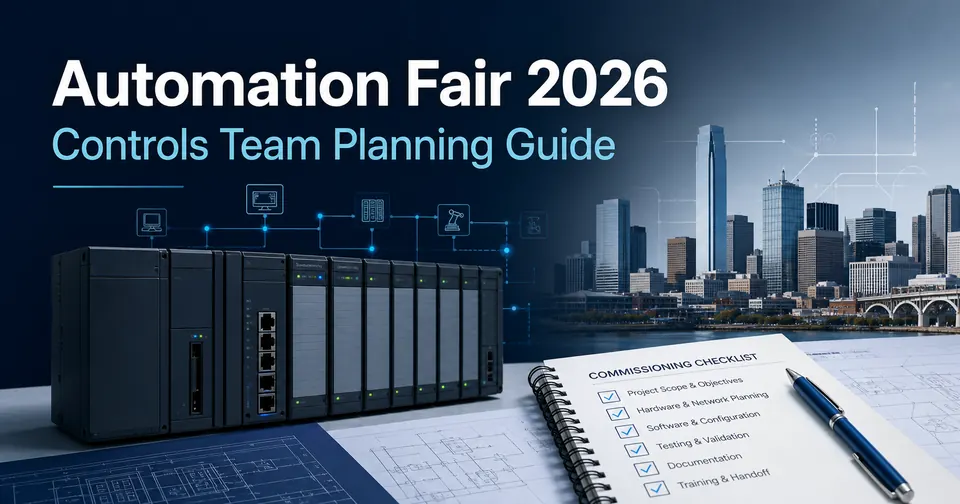
Automation Fair 2026 is scheduled for November 16–19 at the Thomas M. Menino Convention & Exhibition Center in Boston. Registration is open, and Rockwell Automation is positioning the event around industrial operations, automation, software, artificial intelligence, cybersecurity and digital transformation. The official program describes more than 150 interactive exhibits, over 250 educational sessions and more than 500 hours of advanced training.
Those numbers make the event significant, but they can also make it difficult for a plant or project team to decide where to focus. A useful visit should not be measured by how many booths the team sees. It should be measured by how many real operating decisions become clearer after the event.
For controls teams, the best preparation starts with current plant constraints: unsupported PLC hardware, inconsistent HMI standards, weak diagnostics, undocumented networks, difficult commissioning, cybersecurity exposure or a modernization project that has not yet been scoped. These problems can be converted into a focused evaluation plan before anyone books sessions or walks the expo floor.
Start with operating problems, not product demonstrations
Before selecting sessions, list the three to five operating problems that create the most risk, downtime or engineering effort. The list should be specific enough to test a proposed solution.
Instead of writing ‘modernize the PLC,’ document the installed controller family, remote I/O, drives, safety interfaces, HMI, historian, industrial networks and third-party connections that must continue to operate. Identify the outage window, fallback requirements and evidence needed before production can restart.
Instead of writing ‘improve alarms,’ identify where operators lose time: unclear priorities, repeated nuisance alarms, missing first-out indication, inconsistent acknowledgement behaviour or poor navigation from an alarm to the affected equipment.
A short problem statement helps a team compare technologies without allowing a demonstration to redefine the project.
Evaluate PLC modernization as a system boundary
Controller replacement is rarely isolated. A PLC modernization may affect I/O wiring, safety circuits, drive communications, recipes, HMI tags, historian collection, spare parts, maintenance tools and validation records. The most valuable modernization discussions are therefore about boundaries and migration risk, not processor specifications alone.
Controls teams should ask vendors and integrators:
- Which legacy interfaces can remain during a phased migration?
- How will existing I/O, drives and third-party equipment be tested?
- What is the rollback plan if the cutover cannot meet acceptance criteria?
- How will controller, HMI and network backups be managed before and after startup?
- What diagnostic information will be available to maintenance after handover?
Treat OT cybersecurity as an operating requirement
Cybersecurity will be a major Automation Fair topic, but a controls project needs more than a general security message. Plant teams should connect security decisions to system availability, recovery and ownership.
Useful evaluation questions include:
- Who owns switch configuration, firewall rules, remote access and user accounts?
- Can the team inventory controllers, HMIs, servers and firmware without interrupting production?
- Are backups current, restorable and stored outside the affected system?
- What happens to control and operator visibility if a server, switch or communication path fails?
- How will patches and firmware changes be tested before deployment?
Separate useful industrial data from data collection
Industrial AI and analytics will attract attention at the event. Before evaluating a platform, define the decision the data must support. Examples include identifying a recurring equipment fault, measuring cycle loss, confirming a utility-performance issue or showing which permissive prevents a sequence from advancing.
The required data should then be traced to its source. Teams should verify tag ownership, scan or collection rates, timestamps, data quality, unit definitions and what happens during communication loss. A dashboard cannot correct unreliable source data or inconsistent control logic.
A small, well-defined use case with an acceptance test is usually more valuable than collecting every available tag. Ask how the proposed solution will demonstrate a measurable result and how plant personnel will maintain it after the project team leaves.
Review panel and electrical-design workflows end to end
Electrical design should connect requirements, schematics, panel layout, I/O, terminal plans, cable information and the bill of materials. If panel engineering or EPLAN is a priority, evaluate how a solution maintains consistency across those deliverables and how changes move from engineering to fabrication and field installation.
Questions should cover component data quality, revision control, reusable macros, terminal numbering, cable documentation, enclosure constraints and final as-built updates. The output must be useful to reviewers, panel builders, installers and maintenance teams—not only to the designer who created it.
Make commissioning evidence part of the technology decision
A technology choice is incomplete until the team understands how it will be commissioned. Ask what can be simulated before site work, how I/O and communications will be checked, how interlocks and alarms will be tested and what evidence will be retained.
A controlled sequence normally progresses from document and backup readiness to power checks, network verification, static I/O checkout, manual functions, automatic sequences, abnormal conditions, recovery and performance testing. Exceptions should have an owner and a clear acceptance decision.
Build a four-part event plan
A practical Automation Fair plan can be organized into four parts:
The event should end with a short decision register: what was learned, what remains unproven, which option deserves further evaluation and what evidence is required before purchase or implementation.
- Objectives: Define the operating problems and decisions the team needs to address.
- Evidence: Bring non-confidential architecture notes, equipment lists and acceptance questions. Do not carry proprietary backups or client drawings unless the information is formally authorized and protected.
- Schedule: Select sessions, hands-on labs, summits and demonstrations that directly support the objectives. Some sessions and tours have limited capacity, so early selection matters.
- Follow-through: Assign an owner to record findings, compare options and convert useful ideas into a scoped pilot or project brief.
Turn event learning into a controlled next step
The strongest outcome is not a list of technologies. It is a clearly bounded next action: an installed-base assessment, a modernization roadmap, an HMI standards review, a network-health investigation, a panel-design package or a commissioning plan.
AranVision supports industrial teams with PLC and HMI programming, controls modernization, EPLAN documentation and design support, industrial-network review and commissioning. Event dates, agenda, pricing and registration are controlled by Rockwell Automation and may change. Confirm all details on the official Automation Fair website before making travel or purchasing decisions.
Frequently asked questions
When and where is Automation Fair 2026?
Rockwell Automation lists November 16–19, 2026 at the Thomas M. Menino Convention & Exhibition Center in Boston, Massachusetts.
Is registration open?
Yes. The official event website states that registration is open. Session and tour capacity may be limited, so attendees should verify availability directly with the organizer.
What should a controls engineer evaluate at the event?
Start with real operating needs: PLC modernization boundaries, HMI diagnostics, OT cybersecurity, industrial data quality, electrical-design workflow and commissioning evidence.
Is AranVision affiliated with Automation Fair or Rockwell Automation?
No affiliation or sponsorship is claimed. This is an independent planning guide from AranVision, and event information comes from Rockwell Automation's official pages.
Official and reference sources
The links below support the source facts discussed in this guide. Product claims and event details remain the responsibility of the referenced publisher; confirm current information at the source.
Planning a related controls project?