
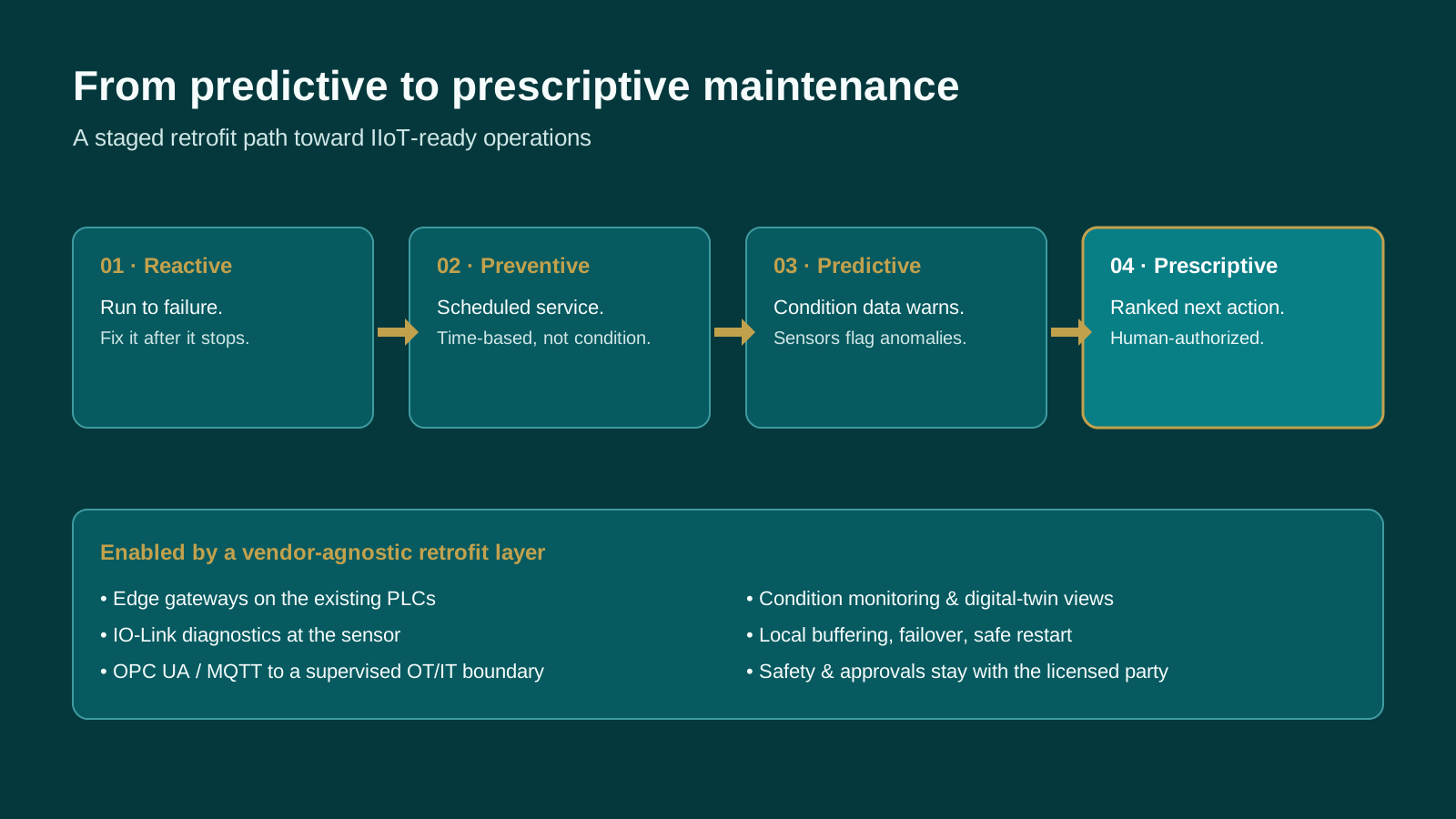
For years, “predictive maintenance” was the goal: put sensors on the machine, watch the data, and act before something fails. At Hannover Messe 2026, the language had already moved on. Vendors increasingly describe maintenance as prescriptive: the system does not only flag an anomaly, it proposes a ranked, root-cause remediation and integrates with the maintenance workflow.
That is a meaningful shift for anyone running a line that was commissioned ten or twenty years ago. The promise is real, but so is the risk of buying a dashboard that never changes an outcome. This article lays out what the shift actually means and a staged, vendor-agnostic retrofit path to reach it without a high-risk rip-and-replace.
It is a planning guide, not a description of a specific AranVision customer installation. Every figure or capability below should be scoped and verified for your own equipment and operating context.
What “prescriptive” actually adds
Predictive maintenance answers “what is likely to happen?” Prescriptive maintenance tries to answer the next two questions: “why?” and “what should we do about it?” In practice that means pairing multimodal sensing with analytics that produce a probable root cause and a recommended action, then feeding that into the CMMS or work-order process.
Industry analysts now describe the market as moving “from prediction to prescription,” with maintenance and troubleshooting as the leading use case for industrial AI agents. The important qualifier is that useful systems keep a human in the loop: the analytics recommend, and an authorized person approves and schedules the work.
For a plant, the value is not the alert. It is the shorter path from a symptom to a correct, scheduled repair, with fewer chased false alarms and less guesswork on the floor.
Why the legacy line is not the blocker you think
A common objection is that prescriptive maintenance needs new controllers everywhere. Usually it does not. The first move is to make the existing controls observable rather than to replace them.
Edge gateways can sit alongside the current PLCs, collect and normalize signals near the machine, and publish a clean, analytics-ready stream. IO-Link devices at the sensor layer report diagnostics, contamination and temperature, and reload their parameters automatically after replacement — which also cuts wiring and commissioning time.
Interoperability standards do the connecting: OPC UA and MQTT bridge OT to IT across vendors, while Single Pair Ethernet and APL extend Ethernet toward the sensor. For a brownfield retrofit, assess IO-Link, APL and SPE against the installed devices, network and permitted downtime. Adding data access without changing working control logic is a design objective that must be verified for the specific site.
- Add edge gateways to the installed base, not a forklift upgrade
- Use IO-Link for device diagnostics and faster replacement
- Publish over OPC UA / MQTT to a supervised OT/IT boundary
- Keep safety functions and control logic untouched until scoped
A staged path that respects production
Modernization earns its keep when it protects uptime. A defensible sequence moves in verifiable steps rather than one big change.
Assess & stabilize: baseline the installed base, interfaces, failure modes, data sources and documentation gaps, and fix the reliability and backup gaps that block everything else. Connect: expose data with edge gateways, IO-Link and OPC UA/MQTT. See: turn that data into condition monitoring, dashboards and digital-twin views tied to real operating thresholds. Predict, then prescribe: grow from condition-based to predictive and, where the payback supports it, prescriptive guidance.
Each stage should be scoped, tested and documented for handover, so the plant keeps a maintainable system instead of a black box that only one vendor understands.
“Self-healing” means resilient, not autonomous
Marketing sometimes implies factories that repair themselves without people. That is not where the technology is. What is achievable and verifiable today is resilience.
Edge components can buffer data during a connectivity loss so key metrics stay available, fail over cleanly, restart safely, and present guided remediation to an operator. Those are real, testable behaviours. Fully autonomous, unsupervised control is not — and safety functions, interlocks and regulated approvals must stay with the responsible licensed or authorized party.
Designing for the resilience you can actually operate and verify is more valuable than promising autonomy you cannot support.
Avoiding the dashboard that changes nothing
The most common failure mode is a good-looking dashboard that never shortens a repair. A few habits prevent it.
Start from the decision, not the data: define which maintenance decisions the system should improve, then instrument for those. Confirm data quality and ownership before layering analytics on top of it. Tie every alert to an intended recipient and a response, and separate “seen” from “resolved.” Finally, measure whether the system actually reduced downtime or chased fewer false alarms — and keep the baseline and method honest.
Cybersecurity belongs in the plan from day one: an OT/IT boundary, access control and encryption at the edge, and an eye on the regulatory landscape taking shape around industrial security.
Frequently asked questions
Do we need to replace our PLCs to reach prescriptive maintenance?
Usually not. Most brownfield programs start by adding edge gateways, IO-Link and OPC UA/MQTT publishing to the installed base, gaining data and diagnostics without a rip-and-replace. Replacement is proposed only when the existing hardware genuinely blocks the goal.
Is prescriptive maintenance just predictive with a new label?
No. Predictive flags what is likely to happen; prescriptive adds a probable root cause and a ranked recommended action, integrated with the maintenance workflow — with a human authorizing the work.
How do we start without disrupting production?
With a scoped assessment of the installed base, data sources, interfaces and goals, followed by staged, verifiable steps: assess and stabilize, connect, see, then predict and prescribe.
Official and reference sources
The links below support the source facts discussed in this guide. Product claims and event details remain the responsibility of the referenced publisher; confirm current information at the source.
Use the guide inside an approved work process
This guide supports planning and technical review; it does not authorize a change to live equipment. Before applying it, identify the system owner, production boundary, electrical and machine hazards, required permits, current backups and the person authorized to approve testing. Keep confirmed evidence separate from assumptions, and record any temporary simulation, force, inhibit or workaround under the site’s approved method.
If the installed condition does not match the available drawings or software, preserve the discrepancy and resolve ownership before downloading, energizing or bypassing a protective function. Final acceptance should reference the actual as-left configuration, executed test evidence, open actions and responsible approver.
Planning a related controls project?